

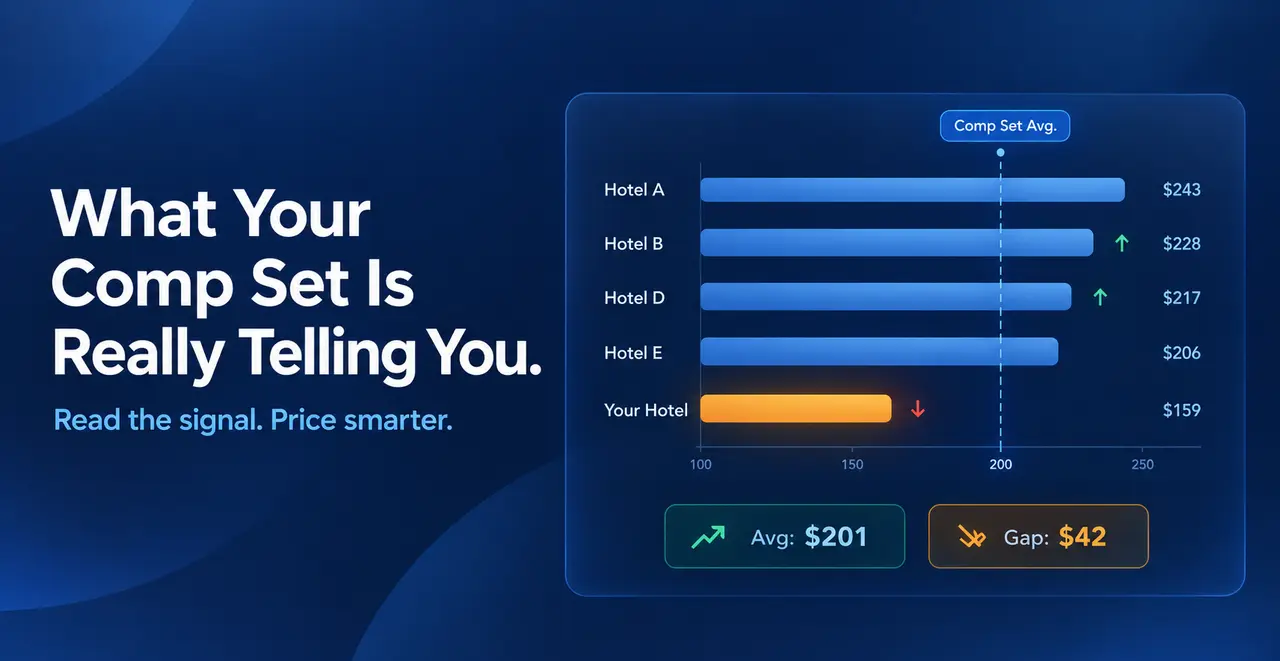
Hotel competitor pricing is one of the most underused tools in independent hotel revenue management, not because hotels aren't watching it, but because most don't know how to read what it's actually saying. A competitor's rate isn't just a number to match or beat. It's a signal about market demand, their booking pace, and where opportunity exists for your property. This guide breaks down how to interpret comp set data and use it to make smarter hotel pricing strategy decisions.
Why Hotel Competitor Pricing Matters for Independent Hotels
Watching what your competitors charge gives you something your own booking data can't: market context. Your occupancy rate and average daily rate only tell you how your hotel is performing in isolation. Hotel competitor pricing tells you how you're performing relative to the market and that's where the real insight lives.
A hotel with strong occupancy and low rates might feel like it's winning. But if every competitor in the market is charging significantly more for the same dates, that hotel is leaving meaningful revenue on the table. Without competitive context, you can't tell the difference between a strong performance and a missed opportunity, which is why comp set analysis is a core part of any hotel revenue management strategy.
What Different Hotel Pricing Moves Actually Signal
Not every rate change means the same thing. Learning to read the signal behind the move is what separates reactive pricing from smart hotel revenue management.
Competitors raising rates well in advance usually signals strong forward demand, an event, a conference, or a holiday weekend driving early bookings. If your comp set is moving up weeks out and you're holding steady, it is worth investigating, but do not raise your rates solely to match them. Always cross check against your own booking pace, pickup trends, and demand indicators available through OTAs before making a move.
A competitor dropping rates last minute often signals unsold inventory and an attempt to stimulate late demand. This isn't necessarily a reason to follow them down. If your own booking pace is healthy, matching their drop only reduces your revenue without filling rooms you needed to fill.
Competitors selling out early is one of the most valuable hotel pricing signals of all. When a comp set property goes unavailable for a date, remaining demand shifts to whoever is still open, including you. That's the moment to hold or raise your rate, not discount it.
Across-the-board low pricing from competitors can signal a slow market, but it can also signal they're chasing occupancy at the expense of ADR. Understanding which it is requires looking at your own booking pace and OTA demand data alongside theirs.
Common Hotel Pricing Mistakes Independent Hotels Make
Reacting immediately. Seeing a competitor drop their rate and matching it right away is one of the most expensive habits in hotel pricing strategy. Their rate change reflects their situation, their booking pace, their inventory, their strategy. It may have nothing to do with yours.
Watching the wrong competitors. Your comp set should be the hotels a guest would genuinely consider alongside yours, similar location, similar product, similar price range. Benchmarking against properties that don't compete for the same guest leads your hotel pricing strategy in the wrong direction.
Treating price as the only lever. If a competitor is consistently outperforming you at similar or higher rates, pricing isn't the whole story. Reviews, online presence, photos, and direct booking experience all influence which property a guest chooses and no hotel pricing strategy fixes a gap in those areas.
How to Use Comp Set Analysis to Strengthen Your Hotel Revenue Strategy
The right way to use hotel competitor pricing data is as one reference point among several, not as the primary driver of your rate decisions.
Pricing decisions should be based on a combination of factors: your own booking pace, pickup trends, and market demand indicators available through OTAs. The comp set tells you what competitors are doing, but it does not give you the complete context for making the right pricing call for your property. A competitor raising rates may be reacting to their own situation, not necessarily the broader market.
Build a simple habit: review your comp set rates at consistent intervals, not hourly, but regularly enough to spot trends before they pass. Look for patterns over time rather than reacting to individual moves. When you see a competitor raise rates, check your own pace and OTA demand signals first. A competitor that consistently prices above you on weekends is telling you something worth investigating, but always validate it against your own data before acting.
And when competitors sell out, act on it. That is the clearest signal the market gives you that demand is real and guests who would have booked there are now looking at your property.
When Hotel Pricing Strategy Alone Isn't Enough
Comp set analysis is a powerful tool, but it only helps you optimize demand that's already looking at your property. It can't generate new demand, secure group bookings months in advance, or build the corporate relationships that fill midweek nights regardless of what the leisure market is doing.
That's where hotel sales strategy picks up where pricing leaves off. Independent hotels that combine smart hotel competitor pricing analysis with proactive corporate and group sales outreach are the ones that build stable, forecastable revenue, not just react to what the market does week to week.
The Takeaway: Read the Signal, Don't Just Follow the Rate
Hotel competitor pricing is telling you something every time it moves. The independent hotels that benefit are the ones that take a moment to read the signal before they react and the ones that treat hotel pricing strategy as one part of a broader revenue management approach, not the whole answer.
At Atica, we help independent hotels put both pieces together: data-informed hotel revenue management strategy alongside the proactive sales effort that builds a booking foundation pricing tools alone can't create.